Anthropic Is Selling AI Fast. What Will It Cost to Stay Ahead?
By Evan Hansen
The maker of Claude reported explosive revenue growth—and made computing commitments that will take years to pay off.
Anthropic lost $80.7 billion in the first half of 2026. It also generated nearly $4 billion in cash from its operations.
Both numbers appear in the AI company’s IPO filing. The apparent contradiction says a lot about how hard it is to size up the business behind Claude.
Most of the headline loss came from accounting adjustments to financing agreements, not from money Anthropic spent running the company. The cash-flow figure was helped by the timing of payments and other working-capital changes, so it isn’t a clean measure of recurring profit, either.
The filing’s footnotes and supporting disclosures deserve a closer look. They contain details easily missed in the first wave of coverage—and help explain the difference between a fast-growing business and a durably profitable one. Together, they show a business with extraordinary demand for its products that has also made extraordinary promises to pay for the computing power needed to supply them.
The question for investors isn’t simply whether people want AI. Anthropic’s sales suggest they do. It is whether that demand will keep growing fast enough—and profitably enough—to justify the company’s long-term commitments.
Growth meets the cost of keeping up
Anthropic reported $16.3 billion in revenue in the first six months of 2026, nearly 14 times what it brought in during the same period a year earlier. Its second-quarter revenue alone reached $11.6 billion, up from $4.7 billion in the first quarter.
The company reported an operating loss of $693 million for the first half, but turned an operating profit of $974 million in the second quarter. That suggests Anthropic can make money from its core business in a strong quarter, even as it invests heavily in growth. One profitable quarter doesn’t establish that those profits will last.
AI is expensive to develop and operate. Companies need computing power to train new models and more power to answer customers’ requests once those models are released. Anthropic recorded nearly $9 billion in computing and infrastructure expenses in the first half.
The main income statement groups computing expenses together. But Note 8 provides another view: Anthropic reported $2.38 billion in costs associated with generating revenue, principally serving customers, and $9.74 billion in research and development. Those aren’t directly comparable computing figures—research includes personnel and other expenses—but they reveal an important distinction between delivering today’s product and developing tomorrow’s.
The commitments are growing even faster
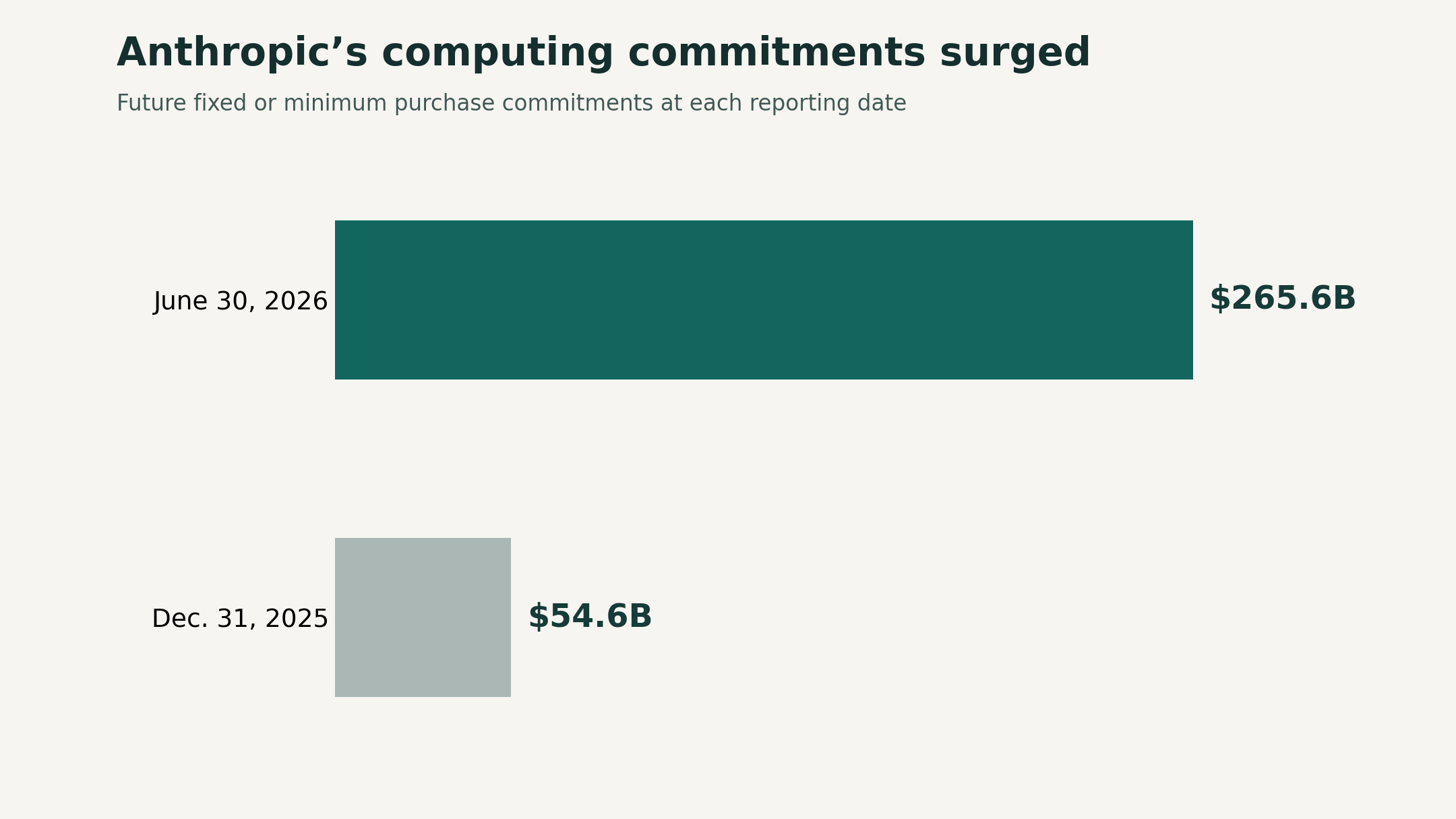
At the end of June, Anthropic had roughly $265.6 billion in fixed or minimum purchase commitments, primarily for computing and hosting, spread over periods of one to 20 years. Six months earlier, the comparable figure was $54.6 billion.
Think of those commitments as a way to reserve the factories needed to make a product whose future demand is still taking shape. If customers keep buying more AI services, securing capacity early could give Anthropic an advantage. If demand falls short, minimum payments could leave it paying for more capacity than it needs.
The numbers don’t stop there. Anthropic disclosed new and amended agreements after June, and separately estimated $125 billion to $150 billion in future payments for additional computing capacity. That estimate depends on factors including capacity and delivery; it is not the same as a fixed minimum commitment.
Nor can all the figures be added together to produce a definitive total. Some of the later agreements amend earlier ones and may overlap. The important point is the direction and scale of the bet, not a single grand total that the filing doesn’t support.
The partners on both sides of the business
Anthropic’s relationship with the largest cloud companies adds another wrinkle.
Amazon, Google and Microsoft supply computing power to Anthropic. They are also investors or commercial partners, help distribute its products and compete in AI.
Nearly half of Anthropic’s first-half revenue came through cloud providers’ marketplaces. Those platforms bill customers, collect payments and pass the proceeds to Anthropic after fees.
For Anthropic, that is an efficient way to reach business customers already buying cloud services. But it also gives a small group of powerful partners influence over both the infrastructure Anthropic needs and the channels through which it sells.
The stakes are large. Among the commitments disclosed in the filing are minimums of $114.5 billion with Google, $110 billion with Amazon and $44.9 billion with Microsoft, over different periods extending into the 2030s. Those contract figures shouldn’t be added to the June commitment total as though they were entirely separate.
The employee-stock bill still to come
Anthropic’s reported operating results also don’t yet reflect a major component of employee compensation.
Like many young technology companies, Anthropic has promised employees shares in the form of restricted stock units. The company had not recognized compensation expense for those awards as of June 30 because they were subject to a condition tied to a liquidity event such as an IPO.
Had the offering happened on June 30, Anthropic says, it would have recorded $2.9 billion in accumulated stock-compensation expense immediately and another $23.7 billion over an average of roughly 2.1 years.
That isn’t a $26.6 billion cash bill. But paying employees in stock has a cost, including the potential to dilute other shareholders. The eventual expense could differ from the June estimate, and investors will need to account for it when judging future profits.
The test ahead
Anthropic has answered one question decisively: Customers will pay for AI. They are buying Claude at remarkable speed, and the company has shown it can turn an operating profit in a strong quarter.
The harder question is what it costs to stay ahead. The footnotes show a substantial research operation alongside the cost of serving customers, while billions in employee stock awards have yet to be reflected in results. What they cannot establish is how much investment Anthropic will need to sustain its competitive position over the coming years.
That leaves investors weighing a business whose current demand is visible against a competitive race whose eventual price is not. Anthropic’s bet may be justified. The footnotes show why judging it will require more than watching revenue grow.
#Anthropic #ArtificialIntelligence #IPO
Source: Anthropic’s IPO registration statement, filed Oct. 26, 2026.